
Customer Payment Terms
Configure Billing Terms for each Account to determine how and when customers pay for their Orders, including payment terms, Credit Limits, discounts, and past-due restrictions.
Configure Billing Terms for each Account to determine how and when customers pay for their Orders.
Choose whether the Account pays when placing an Order, receives individual Invoices, or pays through Statements. You can also configure payment terms, a Credit Limit, early payment discounts, late fees, and restrictions for past-due Accounts.
Open the Account > Settings tab to configure their payment details.
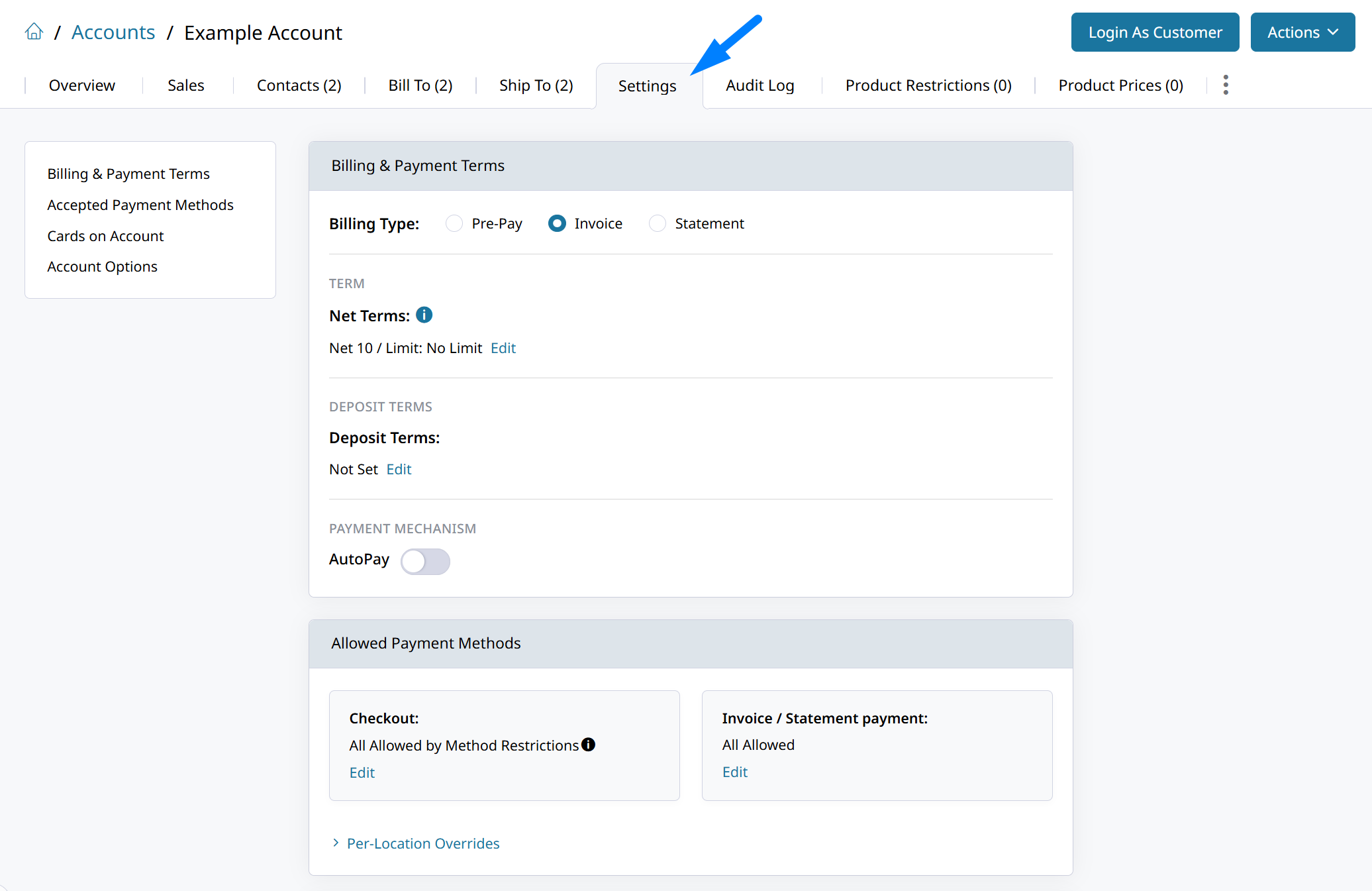
How to Configure an Account's Billing Terms
The Account's Billing Type determines how Orders are billed.
| Billing Type | How the customer pays |
|---|---|
| Pre-Pay | Disables Net Terms. Payment is collected when the Order is placed. |
| Invoice | Enables Net Terms. Each Invoice is paid separately according to its payment terms. |
| Statement | Enables Net Terms. Invoices are grouped into Statements based on the Account's billing schedule. See Statements for setup and payment details. |
Billing Type and Net Terms control different parts of billing. Billing Type determines how the customer is billed. Net Terms determine how long the customer has to pay.
For example, an Account can use Invoice billing with Net 30 terms, or Statement billing with a monthly billing period and payment terms that determine the Statement's due date.
Open the Account from the Accounts List and go to its Settings tab. Locate the payment terms settings to configure its Billing Type and applicable terms.
Invoice due dates are based on the date the Invoice is created and its payment terms. Configure Invoicing Automation to create Invoices at the appropriate point, such as when the Order is placed or a shipment is created.
Net Terms
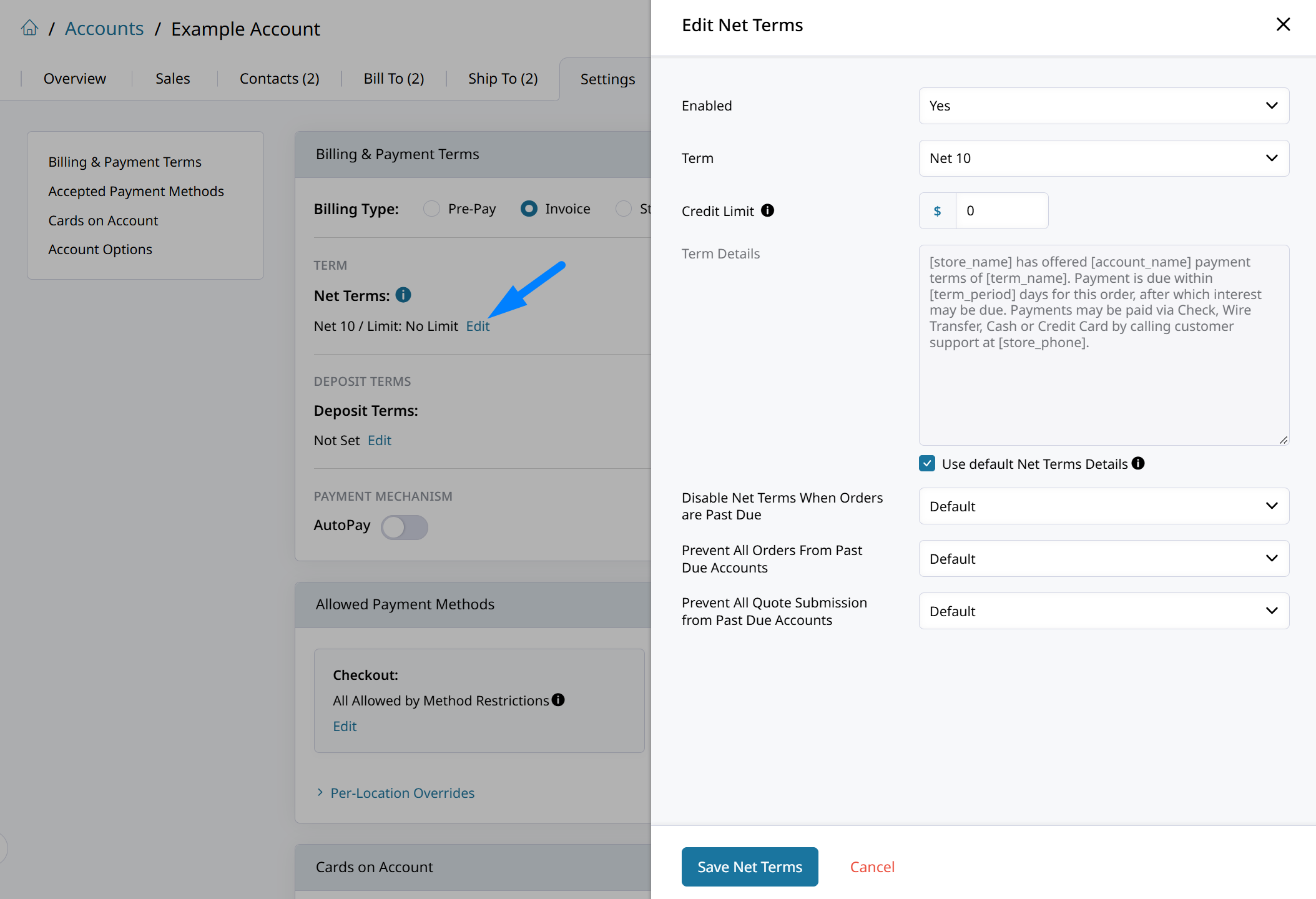
Term
The Term determines how many days the customer has to pay.
For Invoice billing, Net 30 means payment is due 30 days after the Invoice is created. For Statement billing, the Statement due date is calculated from the end of the billing period.
Available terms include Net 10, 15, 20, 25, 30, 31, 45, 60, 61, 75, 90, and 120, or a custom Net %/X NetY term.
Credit Limit
The Credit Limit controls the amount of unpaid credit purchases the Account can have before additional orders using Net Terms are blocked.
Early Payment Discounts and Late Fees
Use Net %/X NetY to configure custom terms with an early payment discount or late fee.
Enter:
- Term Days: The number of days allowed for payment.
- Discount Within Days: The number of days allowed to receive the early payment discount.
- Discount Amount %: The early payment discount percentage.
- Late Fee %: The late payment fee percentage.
For example, a 2% discount within 10 days and a 30-day term offers a discount for early payment, with the full balance due according to the 30-day term.

Term Details
Enter the payment instructions displayed to the customer at checkout and on Order emails and PDFs.
[store_name] has offered you payment terms of [term_name]. Please review your Invoice or Statement for the payment due date. Contact us at [store_phone] with any questions about payment.The following variables can be included:
| Variable | Value |
|---|---|
[store_name] | Store name |
[term_name] | Term name, such as Net 30 |
[term_period] | Number of days in the term |
[store_phone] | Store phone number |
[customer_name] | Customer's full name |
[account_name] | Account name |
[account_location_name] | Account Location name |
[store_name] and [store_phone] are populated from Setup > Site Configuration. [account_name] and [account_location_name] are populated when the checkout is associated with an Account or Account Location.
Past-Due Restrictions
You can limit ordering and quote submission for Accounts with past-due balances.
The available settings include:
- Disable Net Terms When Orders are Past Due
- Prevent All Orders From Past Due Accounts
- Prevent All Quote Submission from Past Due Accounts
Set the Account's option to Yes to enable the restriction, or use Default to follow the global setting.
Global defaults are configured in Web Settings > Customer Settings > Payment Terms. Use Past Due Day Limit to determine how many days past due an Account can be before restrictions apply.
Default Payment Terms Settings
In Web Settings > Customer Settings > Payment Terms, configure the default payment terms and related settings.

These include:
- Net %/X NetY Label Format: Controls how discounted terms are displayed. Specify the format with X, Y, and Z representing discount amount, discount days, and term (for example,
X% Y Net Z). Leave blank to use the default format. - New Net Terms Order Status: Sets the status of newly submitted Net Terms Orders to Pending or Processing.
- Default Net Terms Details: Supplies the default payment instructions.
- Default Net %/X NetY Calculation Total: Determines whether discounts and fees are calculated using the Subtotal or Grand Total.
- Auto-Create Invoices with Order Submit: Creates Invoices automatically for Net Terms Orders.
- Send Invoice Email: Controls whether an email is sent when an Invoice is created through that setting.
- Past-due restrictions and deposit requirements.
See Payment Terms: Deposit Automation for deposit settings.
Because due dates are calculated from the date each Invoice is created, the timing of Invoice creation determines the due date. Use Invoicing Automation to create Invoices at the correct point — either immediately when the Order is placed, or after each shipment is created.
Reviewing Invoices and Balances
Invoices List
Go to Orders > Invoices List to review individual Invoices and their payment status. The list is separated into three tabs: Open, Paid, and Void.
Use the column settings to add Net Terms, Is Past Due, and Due Date.
Payment terms and due dates can be edited on existing Invoices.

Accounts and Orders Lists
The Net Terms tabs provide a view of Accounts and Orders using Net Terms. These tabs cannot be edited or deleted.
The Accounts List Net Terms tab shows each Account's Term, Credit Limit, Unpaid Balance, Account Status (Good Standing or Past Due), and the next or past-due Payment Due date.

The Orders List Net Terms tab shows each Order's Terms, Unpaid Balance, Term Status (Paid, Open, or Past Due), and Payment Due date. Past-due Orders are highlighted in red.

You can also add available terms, Credit Limit, balance, status, and payment due columns to other tabs using the column settings.
In the Account's Sales tab, manage the Orders placed using Net Terms. Use the three vertical dots or bulk actions to view an Order, print an Order, or export to CSV.
Collecting Payment
For Invoice billing, collect payment against the open Invoice. Record offline payments, such as checks, cash, or wire transfers, when they are received.
Creating an Invoice alone does not record a payment. See Paying an Invoice for payment instructions.
For Statement billing, customers pay through the Statement unless Allow Payment by Invoice is enabled.
AutoPay can collect Invoice payments automatically. See AutoPay for configuration and supported billing workflows.
Statements on the Storefront
Customers can review their Invoices and billing information from their Account.
Statement billing groups eligible Invoices and Account activity into scheduled Statements. A Statement can also be created manually from the Account using Create Statement.
See Statements for information about schedules, due dates, and payment options.
Checkout
When the Account has Net Terms enabled, the Net Terms payment method appears at checkout, displaying the Term Details and available credit.
The Net Terms details are also shown on the Order Success page, in Order emails, and on PDF files.

My Account
When the customer is logged in, their My Account dashboard shows the same Net Terms overview as the Admin. Customers can view and print their Orders.

Assigning Terms to Multiple Accounts
Billing Type and payment terms can be assigned through an Account CSV import, or the Bulk Actions > Update Billing Terms.
When using Bulk Actions > Update Billing Terms, choose a Billing Type for the selected Accounts:
- Pre-Pay: Disables Net Terms and collects payment when an Order is placed.
- Invoice: Enables Net Terms so each Invoice can be paid according to its terms.
- Statement: Enables Net Terms and groups Invoices into scheduled Statements.
- Keep Current: Leaves each Account's existing Billing Type unchanged.
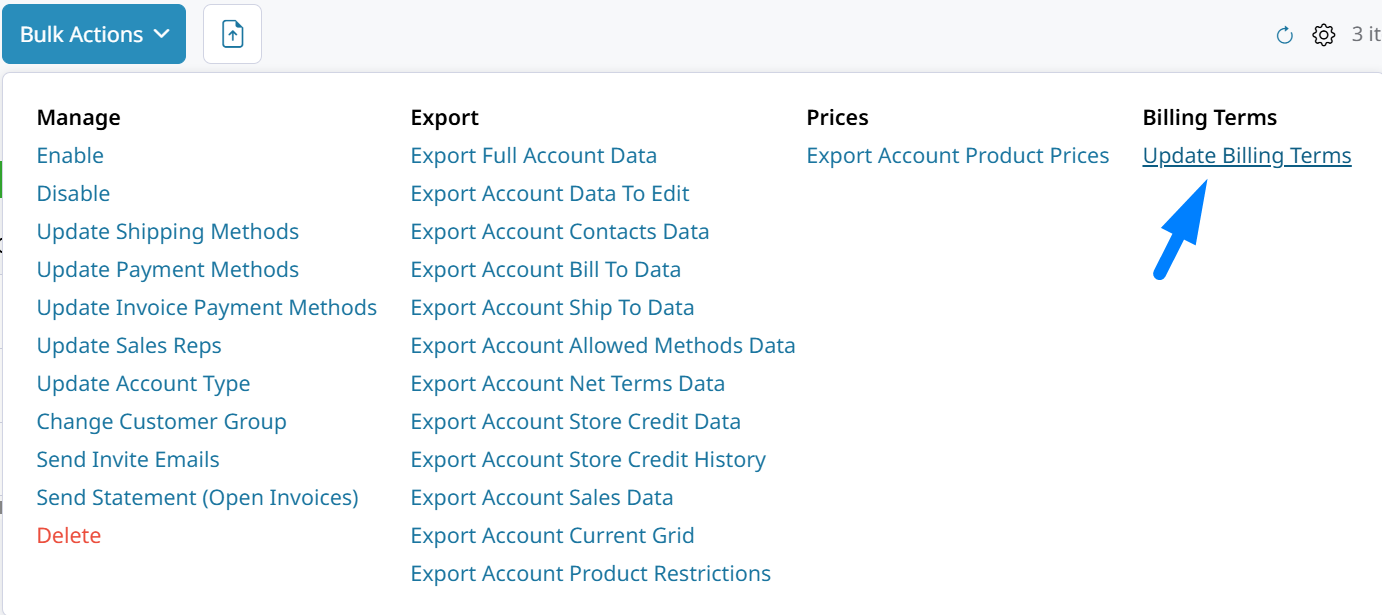
See Assigning Net Terms to Accounts for CSV fields and bulk update instructions.
Billing Terms CSV columns
| Column | Import value | Details |
|---|---|---|
account_name | The Account name | Required. Tells the import which Account to apply the settings to. |
account_billing_type | prepay, invoice, or statement | Case-insensitive. |
account_billing_period | Weekly, Bi-Weekly, Monthly, or Quarterly | Statement only. |
account_billing_cycle_start | 1/1/2026 | Statement only. Excel normalized dates accepted based on Locale settings. |
account_net_term | net10, net15, net20, net25, net30, net31, net45, net60, net61, net75, net90, net120, or net_xy | The Term applied to the Account. |
account_net_term_credit | 100 or 100.0000 | The Credit Limit value. |
account_net_term_details | The Term Details text | Displayed to the customer at checkout. |
account_net_term_xy_days | 30 | Net %/X NetY term length. |
account_net_term_xy_discount_days | 10 | Net %/X NetY number of days to pay within to receive the discount. |
account_net_term_xy_discount_amount | 2 | Net %/X NetY discount percent for early payment. |
Updated 14 days ago